
A mystery vegetable and some great translations
Hello from freezy London. I’m sure you’ll all be relieved to hear that I had a reasonable flight and am now safely ensconced in a cosy room with a cosy radiator. The temperature has dipped to 2°C (36°F) – a temperature I haven’t had to endure since Patagonia back in 2009.
I don’t really have a lot else to say about being in London yet, so instead I’m going to continue on from my last post about the wonderful Hortifruti. First off, a mystery vegetable I spotted on my last shopping trip – can someone tell me what these are?

Any ideas what these are? What do you do with them?
Just because of their rather interesting appearance, I’d love to hear that they have an amazing, intense flavour. But my instinct (and the very low price tag – R$ 1.11) tells me that these have about as much flavour as Chuchu.
Next up I’d like to consider these intensely green fellows:
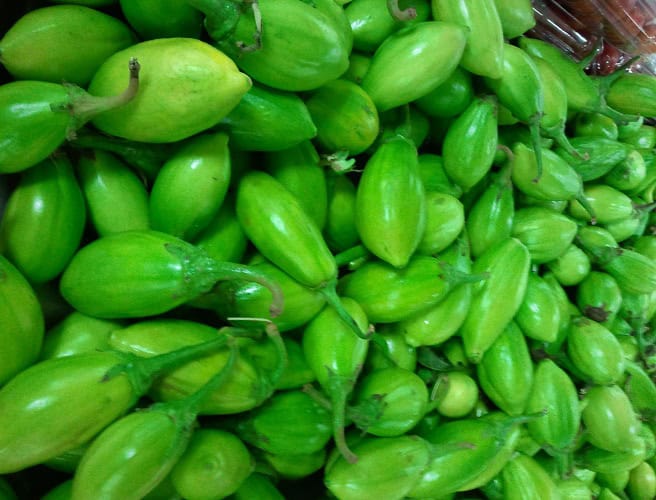
Have you tried these before? Do you think they look nice?
I know what these ones are called as I’ve seen them a couple of times before – they’re called Jiló. I’ve never tried them because someone told me they are bitter and somehow their appearance and the name made me believe it. Any jiló fans out there?
I have to say I felt a little self-conscious about taking these first two photos in the Hortifruti – people kind of look at you and wonder what you’re up to. But after a while I stopped worrying about that and just snapped whatever caught my eye. Which is just as well because as I was looking for pimenta do reino (black pepper) I stumbled across some brilliantly terrible herb/spice translations.
I don’t suppose these will be very funny to people who don’t speak Portuguese, but they made me chuckle:

"Folha de Loura" is the Portuguese for Bay Leaf, which is used in plenty of Brazilian dishes. But "Louro/a" is also the word for blond. Pó can mean dust or powder. What should have been 'Ground Bayleaf' came out as 'Blond in Dust'.

"Doce" means sweet, but can also mean what we English call "sweets" and what the Americans call "candy". This Sweet Paprika came out as Paprika Candy - yummy!

"Tempero" actually means "seasoning", "Ervas Finas" really just means "herbs". Somehow it came out as the cryptic "Temper completes Fine Grass" which sounds like a clue from a particularly tricky crossword.
What do you think – terrible machine translation? Or perhaps these labels were somehow translated into an intermediate language first, and then translated into English? However it happened, I’d like to thank the good people at Bon Apetit – their labels gave me a chuckle!
The spiny things are maxixe – it’s a kind of gherkin. I have no idea what a gherkin is, I just looked it up:
http://en.wikipedia.org/wiki/Cucumis_anguria
Maxixe is used in the dish called cozido, have you ever had it?
Fun fact: “maxixe” is also the name of a dance in Brazil.
I’m not a fan of either maxixe or jilo :-/
(Those translations are HILARIOUS! …and why machine translators will never put me out of a job ;-) )
Ha ha! Brazil and its dances – did you ever see the dance named after the centipede? I know i’ll spell it wrong, but it’s something like La Craiya.
I’m going to try those crazy bumpy gherkins when I get back! :)
Correction: Lacraia :)
Tom,
Awful translations, you could even think someone used Google translator. Paprika “Candy”, no, not American at all, just a terrible wrong translation, we call it “Sweet Paprika” here in the US as well. :)
Ray
Hi Ray!
I haven’t seen one yet, but apparently there is a brand new London bus that will be hitting the streets of London soon. I’m going to try to find a link – they look VERY cool!
Edit: Here it is: http://news.bbc.co.uk/today/hi/today/newsid_9698000/9698602.stm
Holy cow, I don’t think even Google Translator can be insulted with such a bad translation! That must be from the likes of Bing of Babble Fish…sigh. Some people have no notion of languages!!!! One more “sigh” for good measure.
I hope you enjoy your time in England!
Thanks Danielle! It is so cold here… :( BUT, the beer is great! :D
Jilo is an acquired taste. If you like tonic water (without the gin) there’s a chance you might like jilo. It’s a similar level of bitterness. If you decide to go for it, try it in thin slices, breaded (“a milanesa”) and deep fried. You might need to salt the slices, leave for a bit in a colander and then rinse before using (like aubergines) but I’m not sure.
Like I was saying, an acquired taste… like the sloppy HTML in my comments :-)
Ha ha! Once I get my computer setup I can fix that for you! But something about the name, Jiló, makes me think I’m going to hate it!
Thanks, that’s how I meant to write it.
“Any ideas what these are? What do you do with them?”
You see a doctor.
Tom and workmates daydream during work in London.
That’s amazing – the resemblance to my new workmates is uncanny ;)
Welcome to England Tom – it can only get warmer …!
Thanks Eleanor – I hope you’re right! If it get’s any colder I may have to quit and get on the next plane to Brazil! :)
ahahahahahahahahahahaahahahahahahahahahahahaha
You have GOT to send these to kibeloco.com.br . They have a special section called “Placas do braziu” which consists of mainly these kind of thing. Those are genius!
Hee hee! That site is a great way to keep my Portuguese up to scratch (or not!) :)
Hi, there!
I`m a brasilian (with S) and for a loooong time I just hated jilo, without even trying it, just because I`ve heard it was bitter. Until one day I had a jilo souffle… just awesome! It did the trick and I`ve got adventurous to try it in other ways. Keep an open mind! You might lke it !
Hi Marina – you are 100% right! Shame on me :( I am being an utter hypocrite because I always think people are silly when they won’t try some food just because of the way it looks or because they’ve heard something bad about it. Far better to try it and make your own mind up! A soufflé sounds like a great introduction. Maybe I’ll try it! :D
Thanks for your comment.
I’m very late to the party, but jilo is actually called okra in English.
It’s actually pretty common in the Southern US as a side dish for soul food. My husband lived in Alabama as a child :)
Hi there ‘Another Marina’ :) Now then, I don’t want to throw more confusion in here, but I thought Quiabo are what we call Okra. Check out the illustrations in the post: Maxixe, Quiabo, e Jiló/ – looks like these 3 are not the most popular vegetables! I still haven’t tried Jiló (or maxixe) – maybe I’ll get some this weekend!
Well, I believe you are right. In my mind, quiabo and jilo are almost like a single entity, a green two headed alien haunting my idealized childhood.
I say idealized childhood as we never had any of them at home, so all (vaguely threatening) recollection I have from these dreaded vegetable is a patchwork of other kids’ fears.
I only came to eat okra (jilo is still a mystery) 2 years ago in Los Angeles, after my husband dragged me into an American BBQ restaurant. To my surprise, it was delicious, in its deep fried form!!
:)
Ha ha! I know exactly how you feel/felt! :D I like to think that I’ve outgrown the mistrust of strange green vegetables like these, but in truth still feel deeply suspicious of both Okra and Jiló. I’m interested in this idea of deep frying them though – I might have to try that!
Hi Tom,
I’ll check with my husband for a recipe. I’m really good at eating, no so good at cooking. :)
I think you chose wisely ;)
Me too! :)
My husband didn’t have a recipe for deep fried okra, but I found this link:
http://allrecipes.com/recipe/fried-okra/
Sound deliciously straightforward. :)
Thanks Marina – they look really tasty! I’ll pick up some Quiabo next time I’m in the hortifruti :)
I love jiló. I was trying to find it at a Latin grocery store today in California. By the way, Hortifruti is from Espírito Santo, where I was born. I am from Vitória. I used to shop at that store all the time. There was one very close to my home.
Hi Bia! thanks for your comment. I love jiló too! It took me a while to tune in to it’s bitterness, but nowadays I love roasting them in the oven with lots of garlic and olive oil until they’re soft and creamy. Hum! :)