
Canjica – exactly what I was looking for!
Anyone know what this is?

It looks a bit like a pile of broken teeth doesn’t it? In Brazil they call this Canjica, in other countries it is known as hominy.
To use the official name, this is Nixtamalised maize. Apparently, Nixtamalisation is the process of soaking a grain in alkali solution and then removing its husk. Although that sounds worryingly like messing with food in a bad way, Nixtamalisation was developed by the Aztecs and Mayans more than 3,000 years ago and actually makes maize more nutritious!
If, like me, you had never heard of this stuff, you may be wondering what you do with it. Well, all sorts of things actually!
I’ll tell you about the classic Canjica dessert that Brazilians know and love and then we can move on to the reason that I was looking for it (regular readers will not be surprised to hear that my motives were not sugar-based).
First off we soak the canjica (overnight), discard the water, cover with fresh water and cook.

When I first got to Rio I read somewhere that no Brazilian kitchen is complete without a pressure cooker – I bought one the next day! I used to fear pressure cookers massively, but now I think they’re pretty cool – especially for cooking feijão (beans).
With a pressure cooker the canjica will be cooked in an hour:
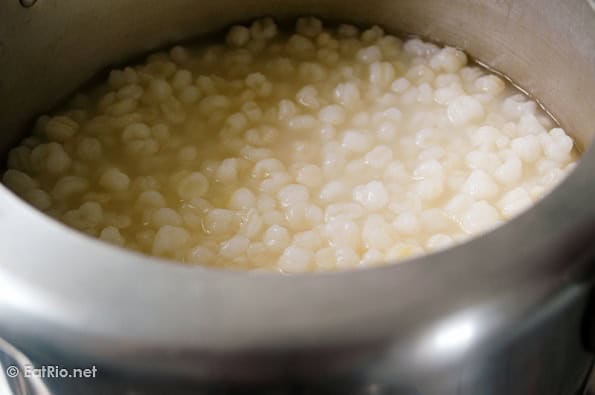
Mmmm, creamy! The grains are now soft but not yet mushy. To me, this looks like rice pudding, and that’s a clue to what Brazilians do next…
OK, so this is where our paths diverge. To make Canjica you would now add creamy things like milk, condensed milk and coconut milk. Into this delicious mixture, even more delicious things are then added: cinnamon, cloves and sugar. My guess is that a little nutmeg (in Portuguese: noz moscada) would also go well, just like rice pudding. Brazilians will probably tell me this is totally wrong, but I bet it would be nice if you added some raisins or sultanas as well.
However, at this point I went off in a different direction. With the help of a blogger named Eva, I made Arepas! Arepas became an obsession of mine during the 4 months I spent in Colombia a few years back. These corn-based patties come in many different shapes and sizes and I have been pining for them ever since I left Bogotá. Eva’s recipe is no longer available, but I followed it to the letter and was very pleased with the results.

You have to pass the cooked grains through a grinder. This bit took me ages, but towards the end I started to perfect my technique – next time will be easier.
After the grinding you are left with some fluffy white stuff that looks a bit like mashed potato. You add some salt and butter and mix well – what you now have is a kind of dough (or massa as they say here). This can be shaped into burger sized patties.

Fluffy massa, just waiting to be turned into yummy arepas.
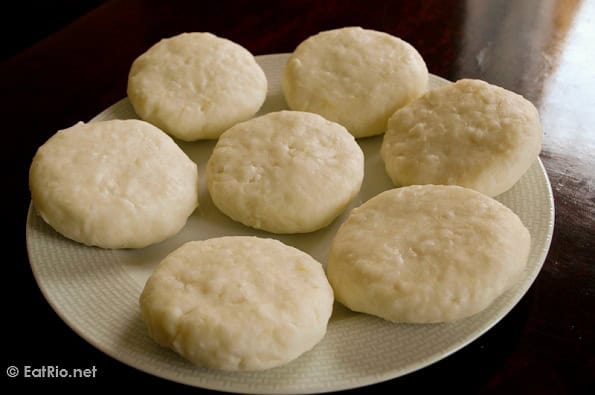
This is the size and shape of the arepas that I loved most, from the Caribbean coast of Colombia (from Cartagena in the west to Santa Marta and Taganga in the east). The arepas in other parts of Colombia are quite different. Arepas are also very popular in Venezuela.
Now then, I don’t want to sound smug, but when I got to the stage you see in the picture above I was feeling pretty good about myself. To my shame, phrases like “I’m a natural” and “Just call me the Arepa King” were uttered. But you have to understand that I have really missed arepas. After eating them every day for months, I have been without them for more than 2 years. It was a pretty exciting moment when I realised that I can now make these things whenever I want…
Having made my patties it was time to cook them. Back in Colombia I saw these things cooked on banana leaves over coals, but I was all out of banana leaves and it was raining outside, so not really the time for a barbecue. Instead I took the easy route and fried them in a pan.

The smell and sight of real arepas cooking in my own kitchen was something pretty exciting for me. I read somewhere that when they are ready they should look like ‘English muffins’ (back in England we just call them ‘muffins’).

The classic arepa con queso that I grew to know and love on the north coast of Colombia. Usually it would be as simple as this – cut it open and sling a load of cheese inside and wait for it to melt. Yum!

Arepas, cheese and my home-made habanero chilli sauce – yummy!
And so it was that I made arepas from the stuff that Brazilians call Canjica. I actually haven’t tried the sweet Brazilian dessert of the same name but I definitely will soon. It’s just that currently I’m eating so many arepas that I don’t have space for pudding!
Hominy is actually a member of the grit family.
I don’t like canjica due to its sweet nature – too sugary for my palate when found in stands. Since I really can’t be bothered to make some myself, and add sugar content to taste, then canjicaless I remain.
Those Arepa things look good ; witnessing someone refer to him/herself as The Arepa King/Queen is a bit unappetizing though. Could this be the reason you were ‘invited’ to leave Colombia?
Btw one ends up finding the coolest thing when researching a topic; some of which have nothing to do with the original inquiry:
http://hominygrits.blogspot.com/
Later Arepa King (ugh).
The Gritty Poet objects to the term The Arepa King – ha! ;) You are absolutely right though Gritty, it was undignified. Unseemly even. No one likes a smugass in the kitchen.
Those tree paintings are very cool.
That looks pretty interesting. Now imagine if you left the salt out and instead dusted them with sugar and cinnamon (or maybe some shredded coconut) after frying. Dessert arepas! :)
On a completely different note, isn’t it funny how we implicitly assume that things developed many years ago (by native indians nonetheless) must be good for us? Conversely, we tend to distrust foods prepared with modern techniques (just picture scientists in white coats with beakers and bunsen burners)? There are good counter-examples for example, smoking tobacco (native indians) and pasteurization (invented in a lab) but the first thing that comes to mind is, “Oh well, if the native indians have been doing it for so long, it must be OK”.
Dessert arepas – I don’t know… But then you know what I’m like about sweet things! :) They’d probably sell like hotcakes…
I know what you mean about the ‘indigenous practice = good / modern processing = bad’ attitude. I guess the older peoples of the world had long periods of time to discover what seemed to work well, but lacked science to be right every time (but still, it’s amazing how many complex and convoluted food/medicine processing methods they discovered this way).
Modern scientists have, well, science to develop processing methods, but are often motivated by profit rather than nutritional value, leading to products like spray cheese [barf]
Agreed! I avoid a lot of processed foods myself. It’s just good to remember sometimes that cheese is a processed food whether it’s made in a traditional manner or using a brand new industrial technique. I mean, you don’t see cheese growing on trees, right? Either way it involves technology but I think you hit it on the head in terms of the motivation behind the process (profit, nutrition, etc).
By the way, I love your hand grinder. I haven’t seen one of those since I was a kid. My gran used to grind coffee and I’d sometimes help out. The smell was amazing…
It’s great isn’t it? I had been looking for something to grind spices and saw someone at the market using one of these for that purpose. Next Christmas it appeared under the Christmas tree (clever wife!). My intention was to use it for grinding up spices, but somehow it sat in it’s box gathering dust. Then I saw Eva’s post about arepas and realised that this grinder is specifically sold as a corn grinder!
The smell of freshly roasted/ground coffee is intoxicating isn’t it? My family lived in Jerusalem for a year when I was a kid and my sister and I used to go nuts for the smell wafting out of the Palestinian coffee shops in the Old City.
The smell of coffee alone is almost better than drinking it. The coffee in question was from a few bushes Gran had in her garden, hand picked and then roasted over a wood fire. Good days… She had another use for the grinder which you probably wouldn’t be interested in either: grinding roasted peanuts and sugar to make pacoca. :)
I’m going to go the whole hog on that one Andrew – I think that the smell of freshly ground coffee actually is better than the taste of drinking it. It’s like I used to rather like the smell of pipe tobacco in a tin. But the smell of the smoke? Bleurgh!
And (inconsistent I know) I actually really like paçoca! I wonder if the paçoca came out with a subtle hint of coffee?
The smell is fantastic, no doubt, but can you absorb any caffeine that way?
There might’ve been a second grinder involved, I don’t remember. Anyway, I prefer pe de moleque but pacoca and banana is a nice combination.
The weather in Rio should be fine for growing coffee. One bush will yield enough beans for personal consumption. Let’s us know if you decide to go for it. :)
By the way – home grown coffee?! That sounds great! You have planted a seed (or should that be ‘bean’?) of an idea! :)
A question that has haunted me for some time: can street, or store purchased paçoca can be transformed into something else – like a sauce, or a rue? The main purpose here, for me, would be to make peanut soup.
Oh, home grown coffee sounds like alot of jackandthebeans-talk (god I’m good).
Gritty – ouch! I think you could use paçoca to make a satay dipping sauce – just add chilli, garlic, coriander leaves, nam pla (thai fish sauce) and lime juice. Smother that over some grilled prawns or chicken and you’ve got some good eating right there. Woah, now I’m hungry!
These look amazing. I was going to ask about the grinder. Possible to make these without one? Is it from Brazil?
Hi Natalie – they are amazing! Well, I think they are… And not because I did anything special – it’s actually a very simple recipe.
My wife picked up the grinder from a shop here in Rio (do you know SAARA? I think she got it from one of the shops there – I’m sure if you browse around the kitchen shops there you’ll find one and it will be a tenth of the price that you’d pay in Zona Sul…).
Once the grains are cooked they are quite soft, so maybe a food processor could do it, but then you’d miss out on the fun of the grinder! ;)
I do know SAARA and given that I have been wanting one of these for awhile this is a good excuse to go back.
Those things, look…interesting.
About the pressure cooker…..what the **** is that thing? And how do you use it!? I’ve heard lots of people talking about how they are common in Brasiw.
It’s a sealed saucepan with a release valve – keeps the pressure (and therefore temperature) higher than normal, meaning it’s quicker to cook things like beans, canjica, etc. In the olden days apparently they would explode if you weren’t careful, but I’m disappointed to find that there are decent ‘exploding pressure cooker’ vids on youtube, so I guess that means that the safety features of modern pressure cookers are doing their job. …which is a good thing I guess…though I quite wanted to see an exploding pressure cooker…
Never heard of canjica before. That said, I LOVE English muffins (drenched in butter with honey) – must be the Queen’s influence on Canada ;) Great post!
Yeah, muffins are the best. Do you also get crumpets in Canada? If muffins are the best, crumpest are even bester… (who says I’m losing my English? ;) )
Oh man…. crumpets??? We sure do get those hot little numbers in Canada!!! AMAZING – love those things!
Very interesting post! I actually made a dish with hominy last night…love that stuff! A restaurant here near my parents simply fries up hominy kernels and serves them dusted in salt and chili powder and a squeeze of lime juice. It’s delicious!
Yum! Chili powder and lime make so many things delicious! So do they cook the hominy first? Or is this like a kind of spicy popcorn?
Hello tomlemes. I’m a carioca who used to have a much better English but now, living in Switzerland since 15 years, I must admit my German has taken over completely… Obrigada pela receita! I’ve just found it in a shop in Zürich… Saudade de tudo! ;) Canjica (mungunzá for northeasters) in this weather will be perfect! Next time I’ll try your Arepas. Many thanks again. Cheers!
Hi Cecilia! How nice to hear from you :) I’ve always thought that many Brazilian dishes make more sense in a cold climate! For example, I love feijoada, but when the temperature is 40°C then I would prefer something less heavy. But during a cold European winter I think these hot, filling dishes must be perfect. Good luck with the arepas! :)